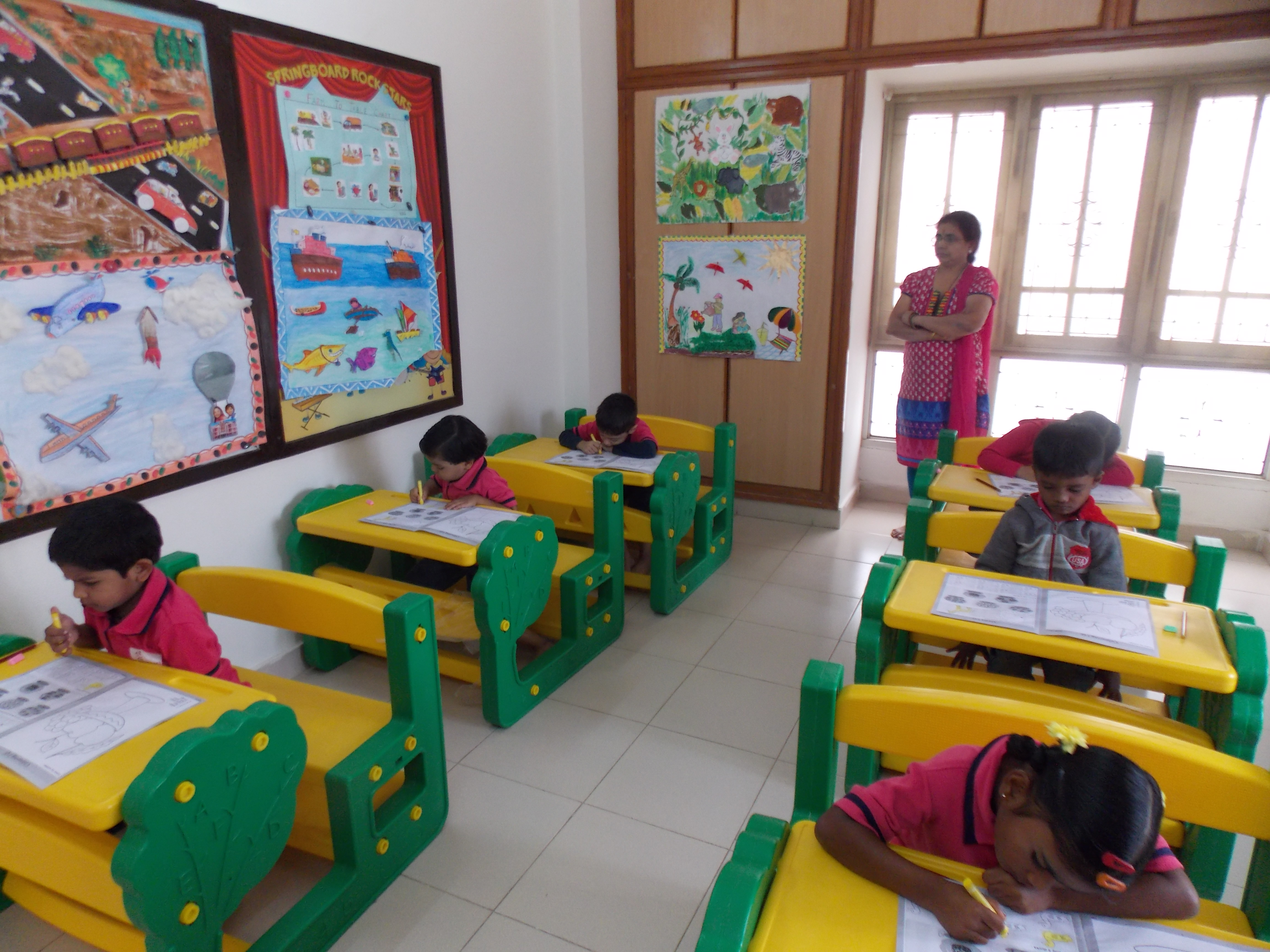
PrePrimary – PrePrimary 2
Early childhood education is the key to the betterment of society
– Maria Montessori
At Springboard Story Time means when adults read ‘with, and not ‘to’ kids. The teacher not only reads to the child but makes room for discussion during story time which takes the experience and the learning to a whole new level. Pronunciation, vocabulary building, sentence formation are all by products of this methodology and children will learn to speak fluently even before he or she learns to read.
The little ones at Springboard are involved in a lot of creative dramatics which means that they are constantly enacting poems, songs, little anecdotes, stories etc which makes them confident children who have absolutely no stage fear. The main difference between creative dramatics and dramatics is that here its not about putting up a perfect show with elaborate props but the focus is on children being taught to just get up and perform with very simple imaginative and inexpensive costumes.
Specially developed digitalised content in the form of games will be used @ Springboard to help the child develop dexterity, hand and eye coordination as well as learn unconsciously while playing. The old idea of using only chalks / crayons so as not to harm the child’s fingers can now be replaced by using the finger itself on digital tabs so as excess pressure is not exerted.
“Creativity is inventing, experimenting, growing, taking risks, breaking rules, making mistakes, and having fun.” This quote summarises nothing else but the essence of a child’s imagination and creativity. Activities @ Springboard will help stimulate the creativity in a child and also learn the art of presentation.
In a constantly changing environment, having life skills is an essential part of growing up and learning. Development of life skills helps children take responsibility for their action and builds confidence and co-operation. Making friends and being sensitive to others is best learnt from an early age.
Children are now eager to express themselves in the written word. We encourage them without stressing too much on spellings and format. We give them the chance to develop the need to write on their own and only guide them when necessary. We introduce reading to children in three stages where they first mechanically read the word, then they read and interpret the word and lastly they appreciate the language, style and story behind what they read.
The process of helping children build number sense is the foundation of fact fluency which begins in the preschool years. Recent research indicates that children begin to construct number sense very early. Hence we nurture this at springboard through various activities.
Number Sense
This is the ability to count accurately—first forward. Then, later in backwards. A more complex skill related to number sense is the ability to see relationships between numbers—like adding and subtracting.
Representation
Making mathematical ideas “real” by using words, pictures, symbols, and objects are practiced to get a clear idea of the representation and remove the fear of maths.
Spatial sense
Later in school, children will call this “geometry.” But for Preschoolers it is introducing the ideas of shape, size and space, position, direction and movement.
Measurement
Technically, this is finding the length, height, and weight of an object using units like inches, feet or pounds. Measurement of time (in minutes, for example) also falls under this skill area. Using fun was like comparing and inferring the essence of measurement is taught
Estimation
This is the ability to make a good guess about the amount or size of something. This is very difficult for young children to do. We help them by showing them the meaning of words like more, less, bigger, smaller, more than, less than.
Patterns
Patterns are things—numbers, shapes, images—that repeat in a logical way. Patterns help children learn to make predictions, to understand what comes next, to make logical connections, and to use reasoning skills.
Problem-solving
The ability to think through a problem, to recognize there is more than one path to the answer. It means using past knowledge and logical thinking skills to find an answer.